Speech-Language Therapy
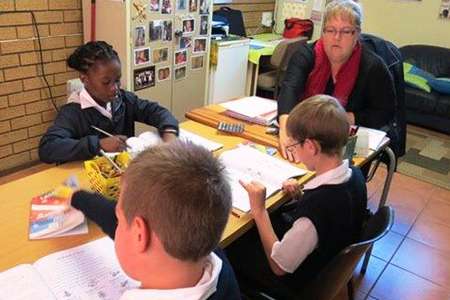
The Speech-Language Therapy and Audiology Department at Lantern School consists of a dedicated team of eight professionals. Learners who require speech-language therapy are seen on a rotational basis, twice a week, either individually or in small groups of 2–3, depending on their needs.
Additional therapy is provided for learners requiring more specialised support, such as those who stutter or present with auditory processing difficulties.
Speech-Language therapists work closely within the school’s multidisciplinary team: psychologists, occupational therapists, learning support staff, and teachers. Placement decisions and therapy planning for each new learner are made collaboratively to ensure optimal support.
Our Role
At Lantern School, speech-language therapists provide comprehensive speech and language assessments for all new learners. Based on the diagnosis and in consultation with the multidisciplinary team, individualised therapy programmes are developed.
Speech-language therapy may include intervention in the following areas:
- Motor Speech Disorders (articulation, phonology, stuttering, oral apraxia)
- Voice Disorders
- Receptive and Expressive Language Disorders
- Aural Rehabilitation
- Auditory Processing Disorders
- Pragmatics (social use of language)
In addition, therapists conduct a hearing screening during each new speech and language assessment. Where results indicate possible concerns, referrals are made to audiologists with equipment for diagnostic assessments, or to medical professionals such as General Practitioners or Ear, Nose and Throat specialists.
Our Aim
The ultimate goal of the Speech-Language Therapy Department is to ensure that learners are equipped to achieve their full potential and successfully complete their matric qualification at a GDE level. Where appropriate, learners may also be reintegrated into mainstream schooling, depending on their progress.
When necessary, learners are provided with special accomodations during assessments. In these cases, therapists read or transcribe test responses verbatim to ensure that learners are assessed on their knowledge, rather than being limited by their reading or writing challenges.
Relevant Definitions:
- Hearing Loss
A reduction in the ability to perceive sounds at certain frequencies (250Hz–8000Hz). Hearing loss may vary in degree (mild to profound), type (sensorineural, conductive, or mixed), and configuration. Treatment may include medication such as ear drops or antibiotics, surgery, hearing aids, or cochlear implants. - Auditory Perceptual Difficulties
Despite having normal hearing, some learners may struggle to process auditory information. Challenges may include auditory analysis and synthesis (segmenting and blending sounds), rhyming, syllabification, closure (filling in missing sounds), sound discrimination (hearing subtle sound differences), auditory memory (recall), and auditory sequencing (ordering words, numbers, or stories). - Receptive Language
The ability to understand and attach meaning to spoken language. This includes hearing words, storing them in memory, forming concepts, categorising, reasoning, understanding figurative language, and producing independent thought. - Expressive Language
The ability to communicate thoughts effectively in an age-appropriate way. This involves word selection, sequencing, and neuromuscular coordination for speech production, supported by prosody (pitch, fluency, intonation, and speed), body language, and pragmatics.